

Same label, different contract
“Own Occupation” is one of the most important words on a physician’s disability policy. It’s also one of the most misunderstood. People say it as if every contract means the same thing, but they don’t.
The biggest difference comes down to one question: if you can’t practice your specialty but can still work in medicine, does the policy consider you disabled?
In this short video, I explain why a policy that says “own occupation” isn’t always true own occupation. Some association policies use the label, but working in another role can offset or cancel your benefits. Look for language that pays based on the material and substantial duties of your own occupation, even if you’re gainfully employed doing something else.
The four definitions
True Own Occupation (specialty specific). You’re considered disabled if you can’t perform the material duties of your specialty. In its strongest form, your benefits aren’t reduced if you go on to work in another occupation, even another area of medicine.
Own Occupation (not specialty specific). Your occupation may be defined more broadly, such as “physician,” rather than your specialty. If you can’t do your specialty but can still work as a physician in some other capacity, the insurer may decide you aren’t disabled at all.
| True Own Occupation | Own Occupation (not specialty specific) | Modified or Transitional | Any Occupation | |
|---|---|---|---|---|
| Occupation measured | Your specialty | Your occupation more broadly | Your own occupation | Any job you’re suited for |
| Can’t do your specialty, can work elsewhere in medicine | Generally counts as disabled | May not count as disabled | Depends on contract wording | Generally not disabled |
| Working in a new role | Benefits generally not reduced | Depends on contract wording | Benefits reduced to cap total income | Benefits generally stop |
| Where you’ll often see it | Individual policies | Individual policies | Individual policies | Group employer plans |
Modified or Transitional Own Occupation. You’re considered disabled if you can’t do your own occupation. If you choose to work in another occupation, benefits continue but are reduced so your new earnings plus benefits don’t exceed what you earned before the disability. It costs less, but it limits what you can earn if you start over in a new role.
Any Occupation. You’re considered disabled only if you can’t work in any occupation you’re reasonably suited for by education, training, or experience. This is common in group long-term disability plans through employers. Many start with an own-occupation definition for a limited period, often 24 months, then switch to any occupation. Group plans can carry real value, but benefit caps, weaker definitions, taxes, and coverage that ends when you leave the job can leave a physician with big gaps.
Why it matters
Picture a surgeon who develops a hand tremor. She can’t operate anymore, but she could still see patients in clinic or teach. With a specialty-specific True Own Occupation definition, she’s generally considered disabled as a surgeon. With a broader definition, the insurer may say she can still work as a physician. With a modified or transitional definition, she’d be covered, but her benefits would shrink if she took a teaching role. Under an any-occupation definition, she likely wouldn’t qualify for benefits at all.
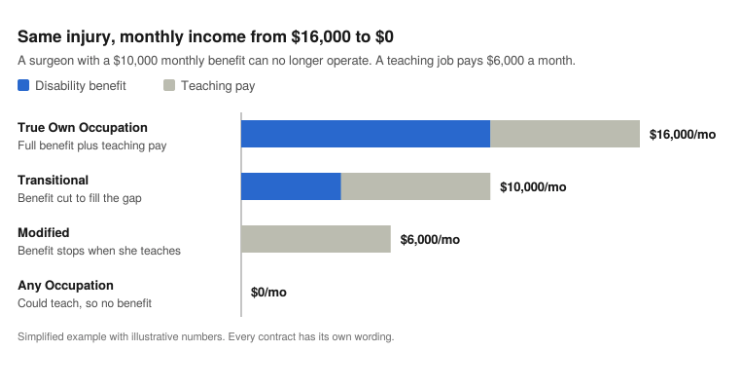
In this example, a transitional definition trims her benefit so her total stays at her old $10,000. A modified definition stops it once she starts teaching.
The value of a strong definition isn’t collecting a check while earning a second income. It’s freedom. If you lose your specialty but still want to contribute somewhere else, a strong definition gives you room to do that. It’s the one feature I wouldn’t cut to save a few dollars.
Questions to ask
- Is my occupation defined by my specialty?
- Are benefits reduced if I work in another role?
- Is there a transitional occupation provision?
- Labels aren’t contracts. Read the actual definition, not just the name on the illustration.